WBG Accountability Analysis · MDB Reform Platform · July 2026
The WBG’s Architecture Problem: Reconciling Sovereign and Commercial Mandates in the World Bank Group
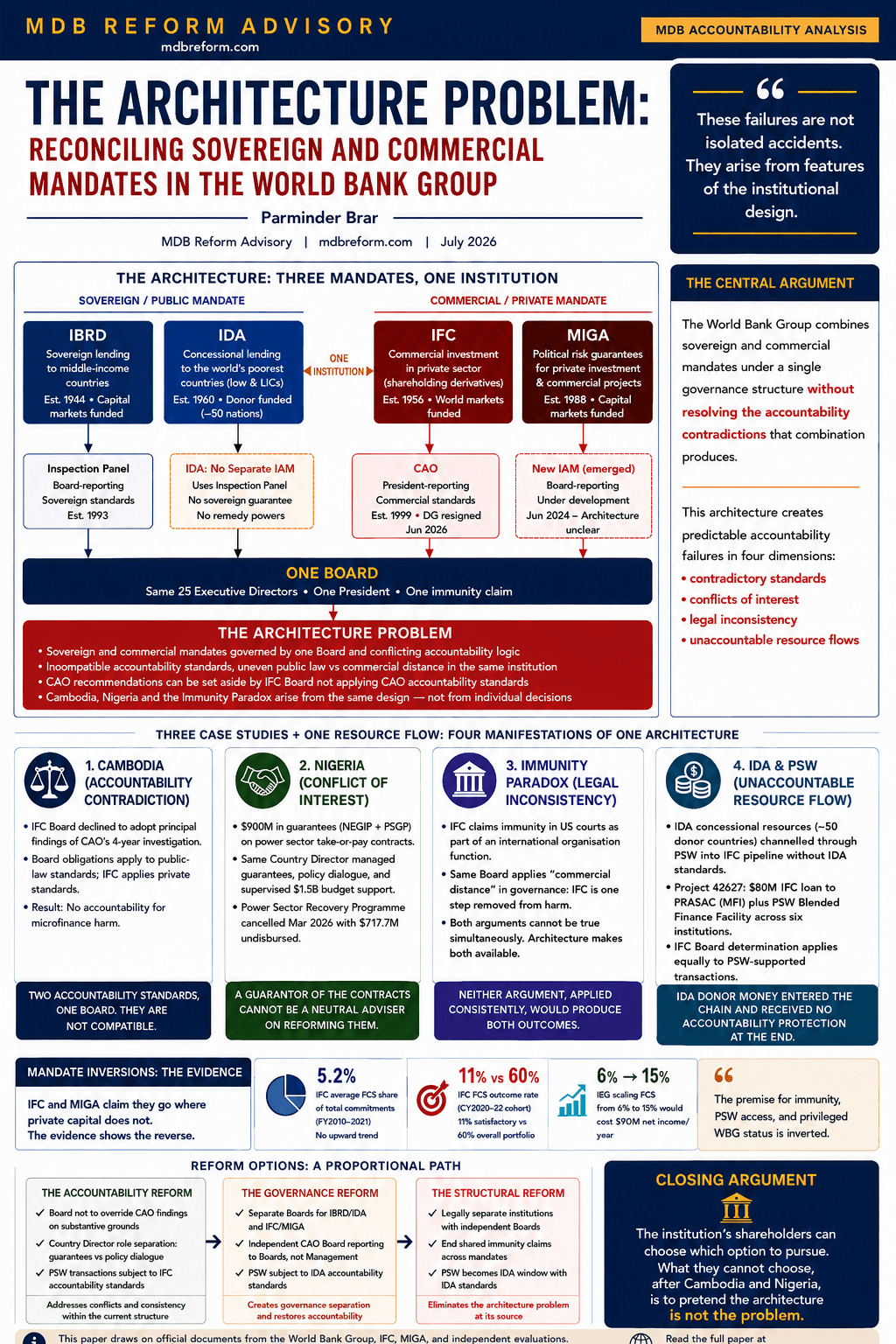
The World Bank Group combines three institutionally distinct financing organisations — IBRD/IDA, IFC, and MIGA — under a single Board, a single President, and a single immunity claim in US courts. The accountability failures produced in Cambodia, Nigeria, and the Immunity Paradox are not governance failures in the conventional sense. They are predictable consequences of an institutional architecture that places sovereign and commercial mandates under one governance structure without resolving the accountability contradictions that combination produces.
Three Case Studies, One Explanation
The IFC Board declined to adopt the principal findings of a four-year CAO compliance investigation, holding that IFC’s Sustainability Framework does not extend to communities harmed through financial intermediary investments. The Board’s reasoning is internally coherent within a commercial framework. The problem arises when that same Board is expected to apply public-law accountability standards to communities harmed by IBRD-financed sovereign projects.
Two accountability standards, one Board. The Board that applied commercial-distance logic to deny accountability to Cambodian microfinance borrowers is the same Board expected to apply public-law logic when communities are harmed by IBRD-financed sovereign projects. A unified mechanism cannot serve both standards without systematically under-serving one.
IFC’s own disclosure confirms that Project 46267 (BOP PRASAC 2022) — an $80 million IFC loan supported by the IDA PSW Blended Finance Facility — is among the institutions named in CAO FI-04. IDA concessional donor resources entered the accountability chain. The Board’s June 23 determination that IFC’s Sustainability Framework does not extend to end borrowers applied equally to PSW-supported transactions.
The World Bank Group held $900 million in guarantee exposure on Nigeria’s power sector while simultaneously advising the government on sector reform. The same Country Director managed the guarantee exposure and supervised a $1.5 billion budget support operation that improved government liquidity at the moment when payment obligations were becoming fiscally unsustainable.
The Power Sector Recovery Programme was cancelled in March 2026 with $717.7 million undisbursed. None of its performance indicators were achieved in 2023, 2024, or 2025. The institution that designed the sector reform had become the institution whose guarantee position made the critical reform recommendation institutionally unavailable.
IFC claims sovereign immunity in US courts on the grounds that it performs governmental functions. The same Board applies commercial-distance reasoning in its own governance on the grounds that IFC is a commercial investor one step removed from project-level harm. Both arguments are available simultaneously because IFC is part of an institution that is simultaneously sovereign and commercial. Neither argument, applied consistently, would produce both outcomes.
A purely sovereign development bank would have no plausible commercial-distance argument in its own governance. A purely commercial institution would have considerably more difficulty claiming sovereign immunity in US courts. The combination is what makes both arguments available. The Immunity Paradox is not a legal inconsistency that better drafting could avoid. It is the direct consequence of the architecture.
Mandate Inversion
IFC and MIGA’s claim to sovereign immunity, PSW access, and privileged WBG status rests on the premise that they go where private capital does not. The evidence documents a systematic inversion of that premise.
Three Reforms the Architecture Requires
Reverse the IAM merger — or, where unavailable, create clearly differentiated tracks within it with separate leadership, standards, and reporting lines. Both tracks report to the Board, not the President. The Board would not override findings on substantive grounds. This is the minimum necessary reform, not a sufficient one.
When IBRD/IDA and IFC are both engaged in the same sector in the same country: disclose the combined exposure, require independent review of whether joint engagement creates a conflict of interest, and in cases of confirmed conflict, require policy advice to be held by a party without a financial stake in the sector. PSW transactions must carry IDA-equivalent accountability standards wherever IDA resources flow.
Structural separation of IBRD and IFC — with independent Boards, independent accountability mechanisms, independent immunity claims, and independent mandates — would resolve the Architecture Problem at its root. Each institution would face a clear binary: sovereign or commercial, with the accountability obligations that each entails. This paper does not argue that structural separation is politically easy. It argues that it is institutionally coherent.