MDB Results 2026: An Independent Assessment — Day 7 of 7
The Full Picture
The last morning in Washington.
Kofi sat by the window of the hotel while his father packed. Outside, the same grey sky. The same streets. Somewhere on Pennsylvania Avenue, the cruise ship. Around the corner, the two battleships facing each other. Across town, the casino and the carnival ship. And in other cities, in other time zones, the dhow, and the Atakebune.
Six days. Six ships. No genie today. They had all said what they had to say.
Kofi had a notebook. He opened it now and read what he had written.
The Six Ships — In the Order He Had Visited Them
Kofi read through his notes a second time. Then he closed the notebook and looked out the window.
His father came and sat beside him.
“What do you think?”
Kofi thought for a long time before answering.
“They are trying,” he said.
His father waited.
“The people in the buildings are trying. The genies knew their numbers. They were not comfortable with the bad ones. The ADB genie was precise and honest. The IDB genie was sad about the twenty-seven percent even while the music was playing. The IFC genie knew exactly what eleven percent meant.”
“And the numbers have not changed in a decade. So trying is not enough. Something else has to change.”
“What would you change?” his father asked.
Kofi looked at his notebook.
“Six ships. Six things. I wrote them down.”
His father was quiet for a moment.
“That is a good list.”
“It is not a long list,” Kofi said. “None of it is impossible. And the fifth one — the veil of sovereign guarantee — that is the one nobody in those buildings wants to talk about.”
“Which evaluation office is best?” Kofi asked.
His father looked at him carefully.
“The ADB,” Kofi said, not waiting. “The IED validates everything. It signs its name to the disagreement. It publishes the gap. You cannot pretend it is not broken when someone has written it down and put their name on it.”
“And the worst?”
“The IMF. Not because it is bad. Because it does not rate. You cannot fix what you do not measure.”
| Rank | Institution / Evaluator | Why |
|---|---|---|
| 1 — Best | ADB — IED | Validates all PCRs; independent ratings override management; publishes management-IED gap in signed annual report; best operational integration |
| 2 | IDB — OVE | Validates all PCRs; reports to Board; ReTS tracking innovative — but too detached from operations; independence reduces uptake |
| 3 | World Bank / IFC — IEG | Validates all ICRs; reports to Board via CODE — but Board co-authors all loans it approves, compromising independent oversight |
| 4 | AfDB — IDEV | Sample only; validates plausibility, not independent ratings; no published management-IDEV divergence data; weakest of the five |
| 5 — Worst | IMF — IEO | Does not rate lending. Thematic evaluations only. Zero project ratings in 149 countries. You cannot fix what you do not measure. |
“Are they going to get better?” Kofi asked.
His father looked out the window at the grey Washington morning.
“Some of them. Yes. The question is whether they get better fast enough. The Spring Meetings are in two weeks. The same shareholders will sit in the same rooms and hear the same management reports. Aid budgets are under stress. The demand for support is greater than ever. Things have to change. Otherwise — USAID will not have been an outlier.”
“But some of them will,” Kofi said.
“Some of them will. That is how things change. Slowly, then faster.”
An evaluation office that validates every project at every institution — not just three of the six.
A Board that reads the independent evaluation before it approves the next capital increase. Not the management summary of the independent evaluation.
Staff in the field. Not 96% of fragile state investments placed from Washington. People in the room.
A presidency that is open. Selected on merit. The WTO did it in 2021. The precedent exists.
Measuring outcomes, not outputs. Not loans approved — whether the reform happened. Not disbursements — whether the water stayed clean.
These are not radical proposals. They are the same proposals the evaluation offices have been making for a decade. The institutions have the architecture. What they need is the will.
Kofi closed his notebook. His father had finished packing.
His mother came in from the other room. Chinwe. She had been patient all week — patient while her husband took Kofi to the marble buildings, patient while Kofi came home each evening with his notebook full of numbers and ships and gaps. She had said little. She had listened. On the last morning she said:
“I am going home. And I want to take you with me.”
Kofi looked at his father.
“Your mother knows things the genies do not,” his father said.
Chinwe was from Benin City. Edo State. The Niger Delta. One of the most lush and richest regions on the planet. Home to Nigeria’s oil resources. Also the most volatile and dangerous. She had worked in the buildings on Pennsylvania Avenue for years. She knew what was inside them. She also knew what was outside them — in a way the buildings did not.
She wanted to show him a project in her own city that had delivered to her community. People had benefitted. They remembered the project and the team. They also remembered the team member who had been kidnapped. The good and the bad. The rich and the poor. The optimism and the pessimism. She was going to take her son to see the real world away from these paper genies sleeping in their buildings in their basements.
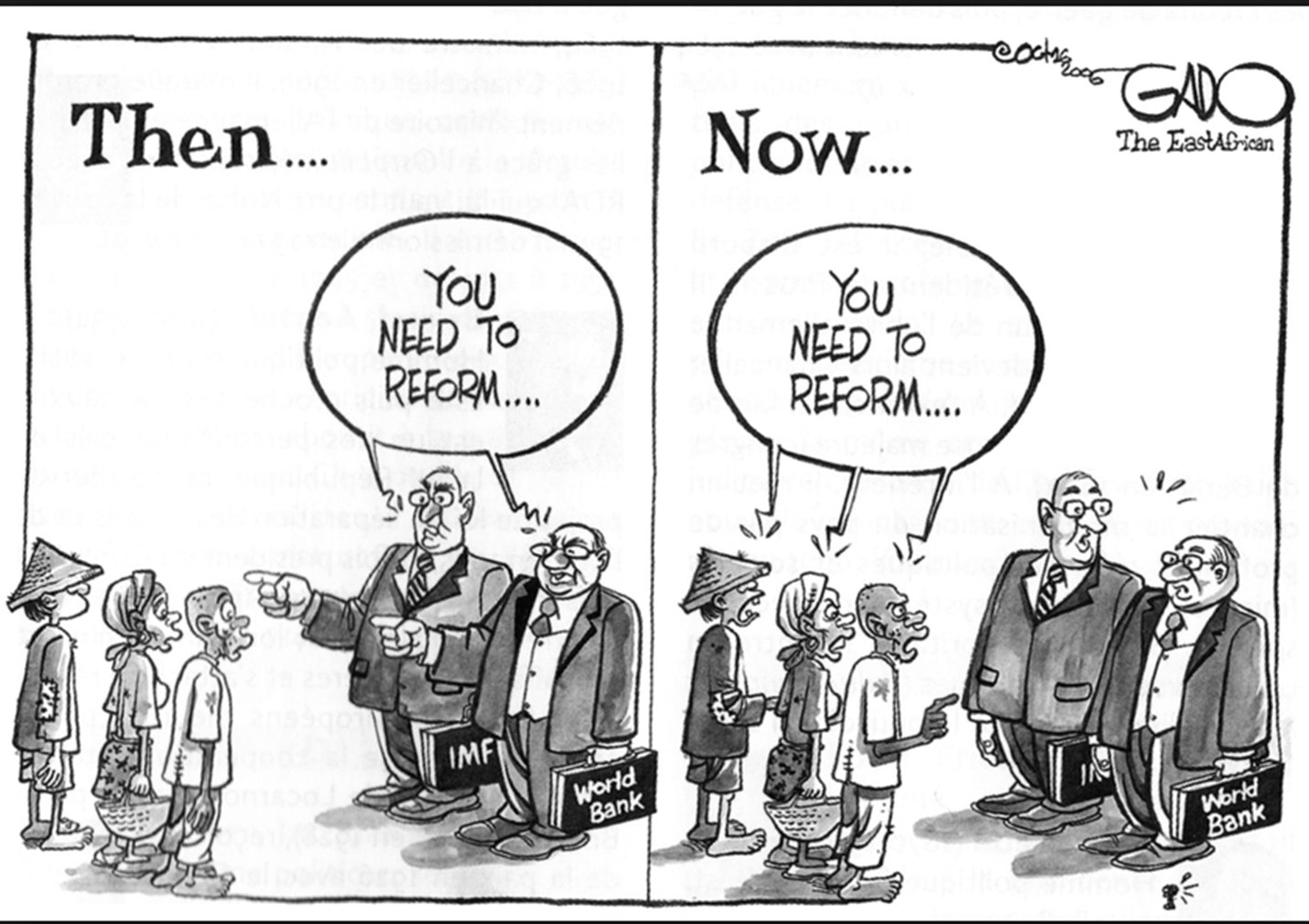
They took a taxi to the airport. It drove down 19th Street. The World Bank on the right. The IMF on the left. Kofi looked at both of them through the window as they passed.
He did not smile. He did not frown.
He was thinking about what his father had said. Slowly, then faster.
He was thinking about the woman in the Haitian painting. The small bridge in a creek. The road that someone GPS-mapped in a flood. The fisheries project that a beneficiary stood in front of a camera and talked about.
The money exists. The institutions exist. The evaluators exist. The evidence exists. The gap between the evidence and the behaviour — that is the problem. And problems that can be named can be solved.
Next stop: Benin City.
His mother’s city. Her people. Her creeks. The place the buildings on Pennsylvania Avenue were built to serve.
He found his own way to the gate.